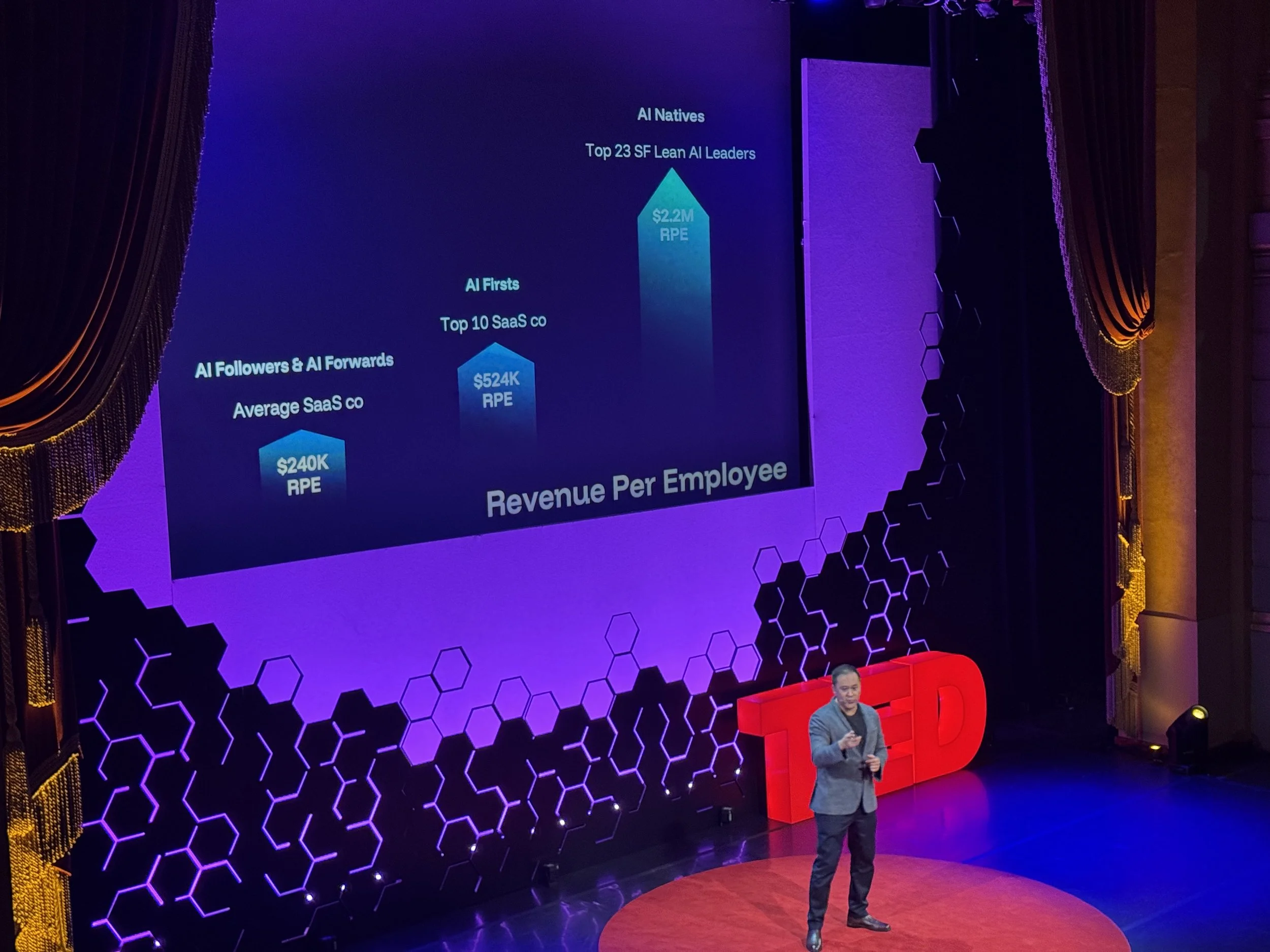
Jeremiah Owyang at TED AI in San Francisco presenting his chart of AI Native SaaS startups as calculated by a mind-blowing comparison of Revenue Per Employee (RPE)
The question, excitedly posed in October, now lingers beyond this year’s TED AI Conference in San Francisco: Are we bold enough?
Absolutely. But that is too simple an answer. The larger answer we seek must come from the follow-on question. This question asks:
Are we even close to imagining the coming transition – and are we prepared for that?
I’m optimistic, but let’s not cheerfully muse away the challenges implied in this broader question – the subject of my new and ongoing podcast (22 episodes so far) and upcoming book: Love Conquers Fear - Humanity, AI, and the Age of Abundance for All.
Answers will emerge. We’ll respond to the call. My deep confidence that accidents do not exist resonated here in San Francisco. My faith that humanity will make it to this new and beautiful Age – my current peg is 95% – was buoyed by two days at this surround-sound parley on the topic of artificial intelligence.
This confidence in my optimism was strengthened by my friend of two decades Jeremiah Owyang, both by his closing keynote of TED AI’s Day One, and with his comments three days later as a guest on episode 21 of Love Conquers Fear. In this conversation – which ranges from stoic philosophy, to our personal health journeys, to the looming disruption and ultimate promise of AI and more – Jeremiah threaded together all the strands of humanity’s ultimate challenge and opportunity.
Jeremiah is a General Partner at Blitzscaling Ventures, leading AI investment with an inspiring focus on agentic software, acceleration of drug development to help banish disease from the planet, radical transformation of learning with AI tutors, and more. He’s peering deep into the future of AI models that will make our current AI tools look like an abacus. In our podcast together and at TED AI, he likened the Bay Area-hubbed AI ecosystem to California’s redwood forests – a unique ecosystem of interconnected energy and vibrance. The future of humanity is being nurtured in countless meetups, hackathons, and other gatherings that combine to yield new startup companies almost daily: “When I started tracking the industry in 2023, there were 3,000 startups, now there are 41,000.”
His central point is that we can only create what we can first imagine. And, he explained, imaginative creation is the very ethos of the San Francisco AI commons.
“In my keynotes, one slide consistently drops jaws,” Jeremiah often says. And that’s the one I shared from his talk above.
Scaling the Revenue Palisades with AI-Native Companies
Jeremiah is one of the most grounded interpreters of AI’s social and business trajectory, and his slide offers a clear lens on how organizations evolve alongside this technology and dramatically increase productivity in many ways.
His categories start with AI Followers, who adopt surface-level tools like chatbots and automation, and he includes in this cohort AI Forwards – those who use AI strategically but without reshaping their core business. The second category is AI Firsts, rearchitecting workflows, products, and org charts around AI as a fundamental operating model. And last but in this case first (in stunningly great capitalistic metrics) are the AI Natives — startups born from code and cognition, where digital agents are co-workers and value creation outpaces headcount by orders of magnitude.
Let me explain the Jeremiah Trilogy as he compares these categories of SaaS companies:
I: AI Follower and AI Forward companies have average annual Revenue Per Employee (RPE) of $240k.
II: AI First companies, by contrast, have an RPE of $524k.
III: But AI Native companies tower above both at an RPE of $2.2 million – 9x the RPE of AI Follower and AI Forward and 4x the RPE of AI First companies!
Jeremiah’s point is not merely taxonomic; it’s moral and practical. The path from AI Follower to AI Native is a story of imagination made manifest — of leaders daring to reimagine work itself. His conviction mirrors my own: the future isn’t arriving by accident. It’s being built — deliberately, imaginatively, and, if we choose wisely, humanely.
To a further point of his, San Francisco – and, for that matter, the culture of the entire Bay Area and much of Greater California – is a kind of commons. A commons of open space and open minds, of open systems and open code. A collaborative digital commons, if you will. The commons has many challenges, but this spirit has only dimmed in San Francisco for short periods of time.
This is where I founded my first VC-backed company, Coremetrics, and where my wife Debra and I made our home in the beautiful Marina. As Jeremiah inspired us to realize, this AI commons is a living canvas upon which so many creators continue to bring their imaginations to life, never fully effacing the work beneath, leaving the strata of innovation that came before.
Grains of Sand That Define the Alchemy of San Francisco
As Steve Jobs is said to have observed: “Silicon Valley is built on sand – but not the kind you find at the beach. It’s sand turned into silicon, and silicon turned into intelligence.” The point of the possibly apocryphal story is that even the most ordinary material — grains beneath our feet — can become the raw substrate of imagination. That alchemy of place and possibility defines the region still.
As Annalee Saxenian, Emeritus Dean of the Berkeley School of Information and one of the great chroniclers of the Valley, once put it: “I've spent a lot of time going around the world to Silicon Whatevers. There's no other place that has generation after generation of people who have been involved in these industries.”
How big is big?
We’re all used to breath-stopping capex figures as Big Tech companies will invest on the order of $400 billion this year and are on track to increase this substantially in 2026 – spending this cash on compute, R&D, and particularly data centers. But let’s look at the more narrow slice of investment at the sharpest edge of disruption – the VC investments going to the fastest-moving startups.
ChatGPT’s estimate as of Tuesday:
Last year, of the roughly $135 billion in global venture capital invested in AI, about $70 billion—or 52 percent—went to Bay Area companies, according to PitchBook and JLL. This dominance has only intensified: global AI funding has reached nearly $193 billion in 2025, and analysts estimate that U.S. startups account for around 60 percent of that total, with roughly half of U.S. AI venture dollars flowing to Bay Area firms. Taken together, that means the region is now capturing on the order of one-third of global AI venture funding—roughly $55 to $60 billion so far this year.(Sources: Bloomberg via PitchBook; PitchBook Emerging Tech Research, 2024–2025.)
At TED AI, we heard from leaders such as Philip Johnston, the founder & CEO of Starcloud, who spoke on the eve of his November 3, launch into orbit of the first NVIDIA H100 GPU space-based data center, dubbed Starcloud-1.
The Imperative to Build and Maintain a Trust Architecture with China
Kai-Fu Lee, the globally renowned builder of bridges across cultures and technologies, is the founder of Sinovation Ventures and Chinese startup 01.AI, an AI platform with a mission: Make AGI Accessible and Beneficial to Everyone. Lee issued an urgent call for us to rethink the war metaphors in our proverbial “race with China”. Rather, said the former President of Google China, we must learn to collaborate – or we all lose. This was a point Jeremiah underscored in our conversation as well, that we are in a “co-dependency” which must endure in some form. I made the point in our Love Conquers Fear episode that I look at Kai-Fu Lee as an important bridge-builder between the US and China.
China is far ahead of the U.S. in robotics, Lee said. I disagree as an admirer and investor (via a Capital Factory fund) in Austin’s Apptronik, whose CEO Jeff Cardenas, a good friend, will be a guest on my podcast in 2026. American investors lead the world in AI while China leads in cross-domain standards. Critically, China also excels across its massive spectrum of energy production and its efficient use. Still, the U.S. is the engine of AI – with massive resources, IP, capital, and computing power.
Lee, who authored AI 2041 – Ten Visions for the Future, shared both the areas where human intelligence will continue to lead, and also the ways and areas where America and China can cooperate for humanity’s sake.
Lee's insights reminded me of The New York Times’ Thomas Friedman, who in September recounted his collaboration over decades with Craig Mundie – co-author of Genesis: Artificial Intelligence, Hope, and the Human Spirit, with the late Henry Kissinger and former Google CEO Eric Schmidt – on the urgency of cooperation with China on AI safety.
“Bad guys are always early adopters!” Friedman wrote. “And without the United States and China agreeing on a trust architecture to ensure that every AI device can be used only for humans’ well-being, the artificial intelligence revolution is certain to produce superempowered thieves, scam artists, hackers, drug dealers, terrorists, and misinformation warriors.”
That’s disturbing. And that’s why Lee’s hope and optimism for the US-China relationship reminded me of the case I made myself to end the “manic arms race”. It is all about fear as I wrote last February in After the Thaw of Two “AI Winters”, a Spiritual Spring Heats Up Our “Consciousness Winter.
“The scramble for analogies is on,” I wrote then of the metaphors – from the Manhattan Project to the Lunar Landing – as journalists struggle to find comparable mobilizations. The analogy we are missing, however, is that of Manhattan Project Director Robert Oppenheimer’s spiritual quest. The nuclear code-cracking physicist’s search – famously in some places, infamously in others – included exploration of the Bhagavad Gita. Oppenheimer understood that physics and consciousness are deeply interconnected.
That was the vibe at this mind-meld of a gathering. A summary of all the joules of incandescence on stage would include Robinhood CEO Vlad Tenev on disruption; WRITER CEO May Habib on the generational torch being passed to new AI pioneers; the Buck Institute’s Nathan Price on personalized health and longevity; Boston University’s Ayse Coskun on balancing data center energy consumption atop an ancient power grid; and so many more.
We all shared a laugh at the insight of Louis Lehot, partner at Foley and Lardner, who reminded us (I’m paraphrasing): “Often we argue whether it’s really annual; many times there’s debate if it’s really recurring; and often, you can dispute if it’s even revenue. But we tend to all agree, let’s pretend. We call it ARR.”
I love this City by the Bay, where my and Debra’s roots run so deep. And I love San Francisco because of – and not despite – my belief in the ethos of my own hometown of Austin, where we are living in a wondrous microcosm of the world to come, as I wrote in 2020. This is as true as ever today; Austin is the best it has ever been (when compared to itself of the past, which is the right comparison point).
So from my not-so-distant, technologist-of-Texas perspective, San Francisco’s innovative greatness is in its many-layered canvases – there is so much that is vivid and inspiring from the history that came before. From Leland Stanford’s tycoon-to-governor-to-educator journey to George Berkeley’s idealist vision, it’s all part of California’s lineage of rushes: gold, oil, film, farms, Levi’s, surf boards, silicon, wine, Web, e-commerce, mobile, social, crypto, and now AI. But it’s also the work, as mentioned, which Saxenian explored in her remarkable 1994 book, Regional Advantage, and shared in a 2018 Bloomberg interview, Why Silicon Valley Hasn’t Moved to Texas (Yet). No one has captured the historical ethos of it all as did Margaret O’Mara in her 2018 The Code: Silicon Valley and the Remaking of America. And few have understood the capitalist mindset of the VCs of Greater San Francisco – those betting billions this year on the future of AI – as has Sebastian Mallaby, who cracked the Valley’s primal code in The Power Law: Venture Capital and the Making of the New Future, published in 2022.
The Reshaping Self in Emerging, AI-Adjacent Form
Needless to say, it’s not easy getting here, as author and forecaster Mary O’Hara-Devereaux wrote in her groundbreaking 2004 study of the winners and losers post-doc-com bust, Navigating the Badlands. As she predicted more than two decades ago, our very identities have been shattered, codified, monetized, atomized, bowdlerized, and echoized. But, as she also predicted, we are now moving into an emergent, AI-adjacent new self, appropriate to what I call the Age of Abundance for All. As O’Hara-Devereaux presented just two months ago, the cycle of disruption and regeneration is proceeding apace with the new generation, as she puts it in: Rebels With a Cause: Gen Z Comes of Age,
But we should not ignore the other, larger corner of this many-layered canvas: San Francisco is not just a gateway to successive waves of technological innovation. This city on an outcropping of rock pushing against the Pacific Ocean is what Daoism calls The Way. It’s a doorway in that sense with which the great African American theologian Howard Thurman founded San Francisco’s Church for the Fellowship of All Peoples in 1944 – partly in reaction to the era’s infamous, sweeping arrests and illegal detention of Japanese-Americans. Still operating, at 2041 Larkin Street, the church’s public honors for community service recipients include James Yee, the Muslim chaplain at Guantanamo’s prison, who wrote of the experience in For God and Country, published in 2005.
The Chumash Archipelago – The Original Influencers
One of the earliest regional faith traditions of which we have knowledge is that of the Chumash, a people whose ancestry dates to 13,000 years ago, according to DNA found on San Miguel Island, in the Chumash Archipelago. That archipelago, which today we call the Channel Islands, was the maritime Camino Real for a civilization that still extends as far south as today’s Malibu, with large communities as far north as today’s Morro Bay and San Luis Obispo.
Devastated by European contact which began with the 1542 arrival of Juan Rodríguez Cabrillo (he of the national monument, college, freeway, and about a dozen K-12 schools of various configurations scattered from Aptos to Lompoc), the Chumash population collapsed from a peak of perhaps 15,000 pre-contact to at most 2,000, by a rough count made in the 1820s. Ethnic cleansing was central, including that from the predations by Franciscan Father Junipero Serra, the genocide of Governor Serranus C. Hastings, and countless abuses by successors of both. Yet the Chumash endure and are now led from Santa Ynez, where the tribe was reestablished in 1901.
The Chumash had a deep understanding of perception and reality, which they revealed in their concept of Anyapax. This word, which has come to us as “Anacapa”, is familiar in the name of an island 11 miles off Ventura’s Port Hueneme. As you’d expect for a coastal sea-faring community, their belief system reflects shape-shifting, ambiguity, a shimmering rather than a concrete reality. This epistemology of Anyapax not only embraces the shimmer of ambiguity and the foggy mist of perspectival truth, it also drives the resilient and durable belief of Californians – including even the “religion of no religion”, once espoused by the Buddhist philosopher Alan Watts. Speaking of which, a good friend just sent me this amazing Alan Watts speech this morning.
There’s a reason Watts founded the California Institute of Integral Studies – the school fusing Eastern and Western philosophical traditions with psychology, spirituality, and social justice, here in 1951. There’s a reason Esalen, the birthplace of the Human Potential Movement, was founded in 1963 by Dick Price and Michael Murphy, just down Highway 1 near Big Sur. There’s a reason Stewart Brand (likely influenced by a rooftop LSD trip taken in 1966) led the campaign that in 1972 published the iconic “Blue Marble” photo of the Earth from space. There’s a reason that Bishop James Pike, of the Episcopal Diocese of California, found a home and following here for his controversial work on post-death consciousness, recounted in his 1968 book, The Other Side.
And there’s a reason my friend from Austin, Manoj Saxena, founder of the Responsible AI Institute, led the best panel for Day Two of TED AI, Aligning and Governing AI in a Global Landscape.
A successful serial entrepreneur, former chairman of the Dallas Federal Reserve, and a pioneer in the foundational tech of AI, Manoj wants us to think more clearly about safety.
“We’re creating an entirely new workforce,” the scope of which we can barely imagine with disruptions we can’t foresee, he said. I was particularly taken in and impressed by his argument that we should create a collaborative public-private entity comparable to the Sematech project in Austin more than three decades ago. He’ll also be on the Love Conquers Fear podcast in 2026.
In Strategic Collaboration: The "Sematech 2.0" Vision for America’s Trade Challenge, an essay I penned last April, I argued for a cross-sector, data-first, public-private partnership designed to address the most vulnerable nodes in our global supply chains serving AI. I flagged the work of one who has considered this deeply: investor and author Balaji Srinivasan. He has reimagined Sematach as a proposal to build smarter, more effective and resilient supply chains with the tools of AI. Hey, we could even have “smart tariffs”.
I’ll leave it there for now and ask again ask the question I posed at the outset:
Are we even close to imagining the coming transition – and are we prepared for that?
Not yet, is the honest answer. But soon we will be, and many of those creating the Age of Abundance for All will be the leaders, creators, and visionaries who generously shared their ambitions and dreams, both publicly and privately in the two-day gathering of TED AI. Thank you friends, new and old, for a gathering of hearts in the Heart of AI. As Jeremiah put it, it’s entirely within our reach and power to create a world of abundance: “It’s feasible if we all want to do it.”
It's not just feasible in my view. It’s imperative.